




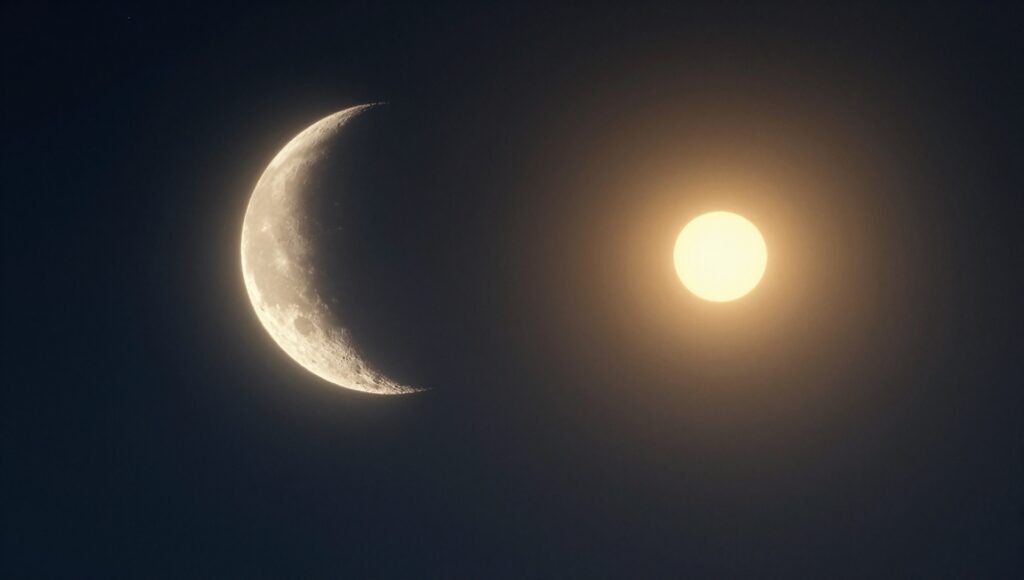
How the Sun Also Contributes to Tides ☀️🌊
When we think about tides, the Moon is usually the first object that comes to mind. The Moon is the main driver of Earth’s tides, but it is not the only celestial body that produces tidal effects.
The Sun’s Powerful Gravity
The Sun is vastly more massive than the Moon. Its enormous mass creates a very strong gravitational field that extends throughout the Solar System. This gravity pulls on Earth, including the oceans surrounding our planet.
However, tidal effects depend not only on the strength of gravity but also on how much that gravitational force changes from one side of Earth to the other. Because the Sun is extremely far away, its tidal effect on Earth is weaker than the Moon’s tidal effect.
Moon and Sun Work Together
The gravitational effects of the Moon and Sun interact to produce different tidal patterns. When the Sun, Moon, and Earth are approximately aligned, their tidal forces reinforce one another.
This produces spring tides, which have higher-than-normal high tides and lower-than-normal low tides. Spring tides occur around the new Moon and full Moon.
Interesting fact: The term “spring tide” does not refer to the season of spring. It comes from the idea that the water seems to “spring forth” more strongly during these larger tidal ranges.
What Happens During Neap Tides?
When the Sun and Moon are positioned roughly at right angles relative to Earth, their tidal effects partially oppose each other. This produces neap tides.
During neap tides, the difference between high tide and low tide is smaller. These tides normally occur around the first-quarter and third-quarter Moon.
Why This Matters
Understanding the Sun’s contribution helps scientists predict how the combined gravitational effects of the Sun and Moon influence ocean water. Accurate tide predictions are useful for navigation, coastal engineering, fishing, marine transportation, and the development of tidal-energy systems.
Tidal energy is especially interesting because tides follow predictable astronomical cycles. This makes tidal movement different from many renewable energy sources whose availability can vary considerably with weather.
A Simple Way to Remember
Think of the Moon as the primary tidal influence and the Sun as an important additional influence. The Moon’s closer distance gives it a stronger tidal effect, while the Sun’s enormous mass still makes its contribution significant.
Together, the gravitational forces of these two celestial bodies help create the changing pattern of ocean tides observed around the world.
Explore more hands-on science and renewable-energy ideas in the DIY section of The Science Online .


